If you have ever evaluated an internal control failure, you know that misclassifying a control deficiency does not just affect a workpaper. For public companies, classifying a material weakness as a significant deficiency means your internal control over financial reporting (ICFR) conclusion becomes indefensible. Management cannot assert that controls are effective, and a material weakness may result in an adverse ICFR opinion. Conversely, over-classifying a deficiency triggers unnecessary remediation efforts, excessive governance attention, and compliance costs that strain your resources without adding value.
Because this classification decision is high-stakes and recurring, you must understand the standards-based framework behind it. In this article, I will explain the definitions under PCAOB AS 2201 and AU-C 265, how auditors evaluate and classify deficiencies, what each classification triggers under the Sarbanes-Oxley Act (SOX), and how AI-assisted platforms support your documentation and review process.
What Is a Significant Deficiency?
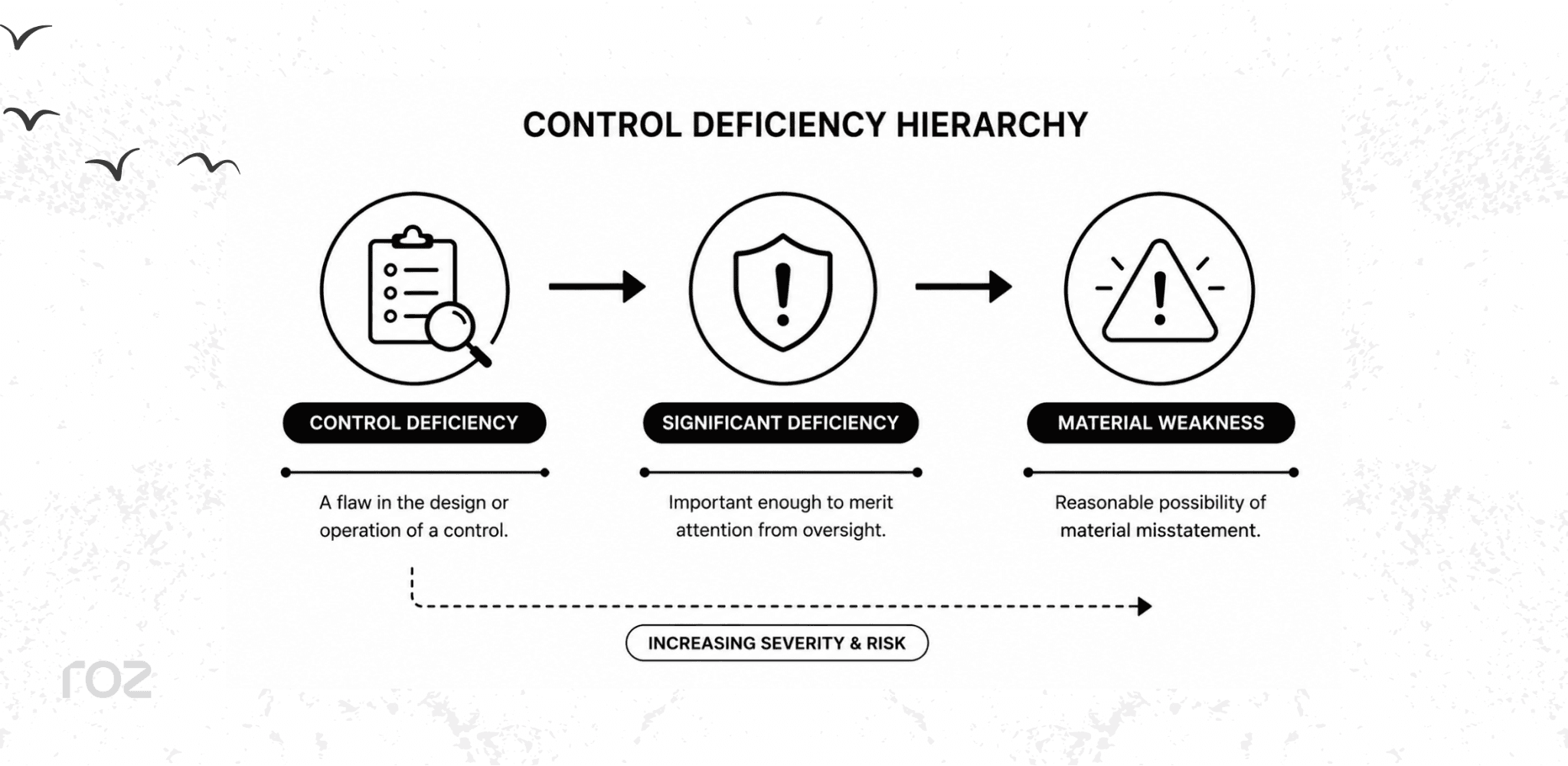
A significant deficiency is a defect or combination of defects in Internal Control over Financial Reporting (ICFR) that is less severe than a material weakness, but that internal control issue or deficiency is important enough to merit the attention of those charged with governance.
Significant deficiencies highlight weaknesses in the control environment as related to the organization’s ability to prevent or detect misstatements. However, the risk is not at the level of a material weakness.
Key characteristics include:
The deficiency exists in the design or operation of a control.
The issue is important enough to be brought to the attention of both management and the audit committee.
It normally pertains to a specific process, account, or reporting area.
The deficiency may elevate the financial reporting risk, but it is less significant than a material weakness.
Common examples include a lack of or inadequate review over journal entries, insufficient documentation for accounting judgment, a lack of adequate knowledge or review in a specific area of financial reporting, and a lack of segregation of duties that is in part mitigated by other controls.
Reporting requirements: Auditors inform management and those in charge of governance, including the audit committee, of significant deficiencies. Unlike material weaknesses, significant deficiencies do not have serious reporting consequences, although they require management attention and governance.
What Is a Material Weakness?
A material weakness refers to a single deficiency or a group of combined deficiencies in Internal Control over Financial Reporting (ICFR) whereby there is a reasonable possibility that a material misstatement of the financial statements will not be prevented or detected on a timely basis.
Material weaknesses are the most serious types of internal control deficiencies because they indicate that internal controls over financial reporting may not operate effectively enough to prevent or detect material misstatements on a timely basis.
Key characteristics include:
It creates a reasonable possibility that a material misstatement would not be prevented or detected on a timely basis.
It would have an impact on annual or interim financial statements.
A material weakness could be represented by one deficiency or several deficiencies considered in aggregate.
An actual misstatement in the financial statements is not a prerequisite for a material weakness.
Common examples include a lack of adequate separation of duties, major IT general control (ITGC) deficiencies pertaining to the financial control environment, ineffective controls surrounding the accounting of complex transactions, and inadequate control of the financial reporting process.
Reporting and disclosure implications: Material weaknesses must be communicated to management and the governing body. For SOX-compliant public companies, the existence of a material weakness means that management cannot assert that ICFR is effective. Material weaknesses impact the auditors’ opinions on ICFR and require a control deficiency to be formally remediated.
Material Weakness vs Significant Deficiency: Side-by-Side Comparison
Factor | Significant Deficiency | Material Weakness |
Severity | Less severe; below material misstatement threshold | More severe: reasonable possibility of material misstatement |
Risk of material misstatement | Present but does not meet "reasonable possibility" standard | Meets or exceeds "reasonable possibility" standard |
Financial reporting impact | Limited; compensating controls may apply | Could affect annual or interim statements materially |
Communication requirements | Written communication to management and audit committee | Written communication to management and audit committee |
Public disclosure | Not required | May require disclosure for public companies subject to SOX |
Audit opinion impact | No effect on ICFR opinion | May result in an adverse ICFR opinion |
ICFR effectiveness conclusion | Management may still conclude controls are effective | Management must conclude controls are not effective |
Why the Distinction Matters
Getting the classification correct directly impacts three areas:
Audit outcomes: A single material weakness can lead to an adverse ICFR opinion under SOX Section 404(b). There is no such condition for significant deficiencies. If auditors find material weaknesses and cannot place reliance on your controls, they will be forced to conduct extensive substantive tests and may have to perform additional substantive procedures.
Governance oversight: Each of these classifications will warrant a different response from your audit committee. While a significant deficiency will require management attention, a material weakness will result in the identification of a serious deficiency in controls that will necessitate public reporting and will have to be remediated.
Remediation priorities: Material weaknesses will require a formal, documented, and reported plan for remediation; control owners; and testing to ensure the control has been fixed and, in many cases, external reporting on the remediation plan. Significant deficiencies do not require such a formal and planned approach to remediation.
How Auditors Classify Control Deficiencies
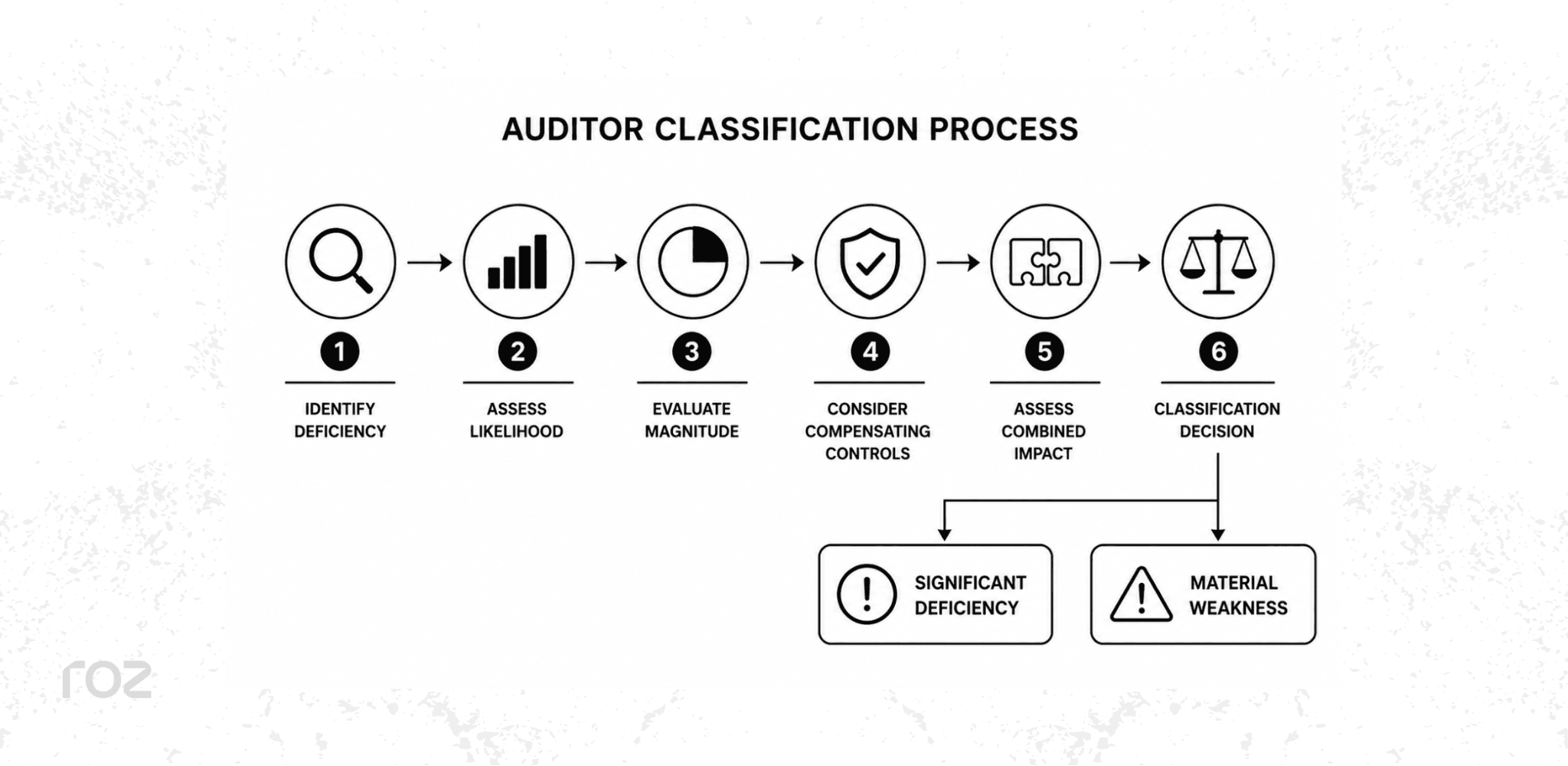
The classification process under PCAOB AS 2201 and AU-C 265 follows a structured sequence. Auditors consider several factors to determine the severity of a control gap.
Deficiency type: Determine if there is a gap in control design or operation. If a control is entirely absent or does not meet the design requirements to either prevent or detect a material misstatement, there is a design deficiency. If a control is properly designed but does not operate as intended due to insufficient execution, authority, or competency, an operating deficiency may exist.
Assess likelihood: Determine if a deficiency is likely to cause a material misstatement. Consider the complexity of the transactions and the control deficiency, the volume of activities, and whether the control deficiency has resulted in a misstatement.
Review critical impact: Look beyond the errors identified during testing to consider the failure's most significant potential impact. Materiality is determined both quantitatively and qualitatively. When thinking about the size of a potential misstatement, consider the nature of the misstatement, the account impacted, and the potential for intentional concealment or fraud.
Consider compensating controls: Consider controls that address the same risk that may fall outside the primary control framework. For example, if automated three-way matching is not implemented for accounts payable, a comprehensive manual review by an independent reviewer may address the risk at a lower level.
Aggregate multiple deficiencies: Consider whether separate deficiencies may pose an amplified risk when considered collectively. A significant deficiency may be considered a material weakness when it impacts the same account or assertion in multiple ways.
Material Weaknesses and Significant Deficiencies Under SOX
SOX Section 404 mandates that all public companies evaluate the effectiveness and report the assessment of their ICFR. This is important for management and audit considerations.
Management responsibilities under Section 404(a): Management is responsible for assessing the design and the operating effectiveness of ICFR as of the end of the reporting period. Management cannot conclude that ICFR is effective if a material weakness exists. SEC disclosure requirements vary depending on the circumstances, but management must disclose material weaknesses and their impact on ICFR.
Auditor responsibilities under Section 404(b): For accelerated filers, the external auditor is required to perform an integrated audit as per PCAOB AS 2201. If a material weakness is noted, the auditor is required to issue an adverse opinion on ICFR. This opinion is distinct from the opinion on the financial statements. However, both opinions are included in the Form 10-K.
Remediation expectations: The expectation is that companies will remediate material weaknesses. However, the persistence data indicates that 31% of companies report the same material weaknesses in successive years. This indicates that remediation is difficult. Effective remediation requires a deep analysis of the causes. For example, a company may add a new reviewer to a process. However, if the added reviewer is unqualified, the underlying control deficiency may remain unresolved.
How AI-Assisted Audit Platforms Support Deficiency Assessments
To apply the likelihood-magnitude framework, an organized and documented assessment of classification decisions needs to be made in order to support and defend the position. Without that, it is nearly impossible to justify classification decisions.
AI-assisted audit platforms aggregate evidence, organize control documentation, and support first-pass analysis of controls and supporting documentation. When evidence is linked to control objectives, classification decisions can be traced to control evidence.
When workflows are standardized, your team will consistently identify deficiencies across all the different engagements. A repeatable process lowers the administrative burden and enhances the quality of documentation and likelihood that essential evaluation activities are completed consistently across engagements, no matter which team member performs the activities.
This organization improves the conduct of readiness assessments. Gaps that are discovered prior to the commencement of a SOX audit can be addressed before testing begins, resulting in fewer surprises with testing.
How Roz Supports Deficiency Assessment Workflows
Roz is an AI platform built specifically for external audit and advisory firms. It helps teams accelerate evidence collection, perform readiness assessments, and execute control testing while keeping auditor judgment at the center of every engagement.
For deficiency assessment workflows, Roz can help firms:
Organize evidence, policies, and supporting documentation in client-specific workspaces
Accelerate evidence collection and documentation review
Surface potential documentation gaps during readiness assessments
Generate AI-assisted first-pass workpapers with source-linked traceability
Maintain audit trails that support reviewer validation and documentation transparency
Roz supports deficiency assessment workflows by helping firms streamline documentation and first-pass analysis. Professional judgment, deficiency classification, and final conclusions remain the responsibility of the engagement team.
Conclusion
The distinction between a material weakness and a significant deficiency rests on a single threshold: whether there is a reasonable possibility that your controls will fail to prevent or detect a material misstatement on a timely basis. This classification directly determines your reporting requirements, audit opinions, and public disclosure obligations.
To ensure your classifications are defensible, you must systematically apply the likelihood-magnitude framework, evaluate compensating controls, and address root causes during remediation. Maintaining consistent documentation and structured workflows across your engagements is one way organizations can manage this process more consistently and efficiently at scale.
Frequently Asked Questions
What is the difference between a significant deficiency and a material weakness?
A significant deficiency is an internal control issue that warrants management and audit committee attention but is less severe than a material weakness. A material weakness creates a reasonable possibility that a material misstatement will not be prevented or detected on a timely basis.
Can multiple significant deficiencies become a material weakness?
Yes. Auditors evaluate deficiencies individually and collectively. Multiple significant deficiencies may be classified as a material weakness if their combined effect increases the risk of a material misstatement.
Does a material weakness always result in a financial statement restatement?
No. A material weakness indicates a control risk, not a confirmed error. An organization can have a material weakness even if no restatement is required.
Must material weaknesses be disclosed publicly?
For public companies subject to SOX, material weaknesses are generally disclosed in management's assessment of ICFR. Significant deficiencies are typically communicated to management and the audit committee but are not publicly disclosed.