Most organizations do not fail HIPAA due to advanced cyberattacks. Instead, many compliance gaps stem from incomplete risk analysis, insufficient documentation, and a lack of operational discipline.
If you're searching for a HIPAA compliance checklist (2026), you’re likely trying to answer one of these questions:
What exactly does HIPAA require?
How can compliance be operationalized beyond documentation?
What evidence do auditors typically expect?
This article is designed to address those questions through a structured, audit-aligned checklist. It does not assume a one-size-fits-all approach. Instead, it reflects how HIPAA is actually applied: risk-based, scalable, and evidence-driven.
Whether you are a healthcare provider, a SaaS company handling PHI, or a business associate, this article provides a practical roadmap to align your controls with HIPAA requirements in 2026.
What Is a HIPAA Compliance Checklist?
A HIPAA compliance checklist helps organizations operationalize HIPAA requirements through structured processes and documentation. To clarify, HIPAA itself is not a certification. Regulatory compliance is managed through the U.S. Department of Health and Human Services (HHS).
Using the checklist helps structure and manage your compliance goals with the three main governing rules: the Privacy Rule, the Security Rule, and the Breach Notification Rule. Compliance checklists foster a risk-based and scalable approach that allows you to design and implement technical and administrative safeguards based on your company’s size, complexity, and risk.
Key HIPAA Rules You Must Address
Privacy Rule: This rule regulates how Protected Health Information (PHI) can be used and communicated, whether in electronic, paper, or verbal form. The rule specifies a “minimum necessary” standard, meaning that the organization should restrain PHI access to the least amount of information to achieve a particular purpose, with some exceptions (for example, in the case of treatment).
Security Rule: This rule is applicable to electronic Protected Health Information (ePHI) and mandates that covered entities and business associates implement reasonable and appropriate administrative, technical, and physical safeguards to ensure the confidentiality, integrity, and availability of ePHI.
Breach Notification Rule: This rule sets forth how data breaches should be addressed. It specifies the circumstances under which a breach occurs and the time frame in which an organization must notify the impacted individuals, the Secretary of HHS, and, in some cases, the media. Notification must occur without unreasonable delay and no later than 60 days after the breach is discovered.
Enforcement Rule: This rule governing the investigations, penalties, and enforcement actions of the Office for Civil Rights (OCR), which is responsible for enforcement.
Why Most Organizations Struggle With HIPAA Compliance
Many companies operate under the misconception that simply buying a new software tool equals HIPAA compliance. The reality is often much more complicated. (Also, managing compliance entirely through manual processes can introduce inefficiencies and increase the risk of errors.)
Compliance failures are often operational rather than purely technical. Common pitfalls include missing risk assessments, weak documentation, incomplete vendor oversight, and poor audit trails. Implementing technical safeguards such as firewalls may help protect your network, but it falls short if your organization lacks the internal policies and procedures to govern how employees interact with sensitive data. This forces organizations to address human behavior and documentation alongside technical configurations.
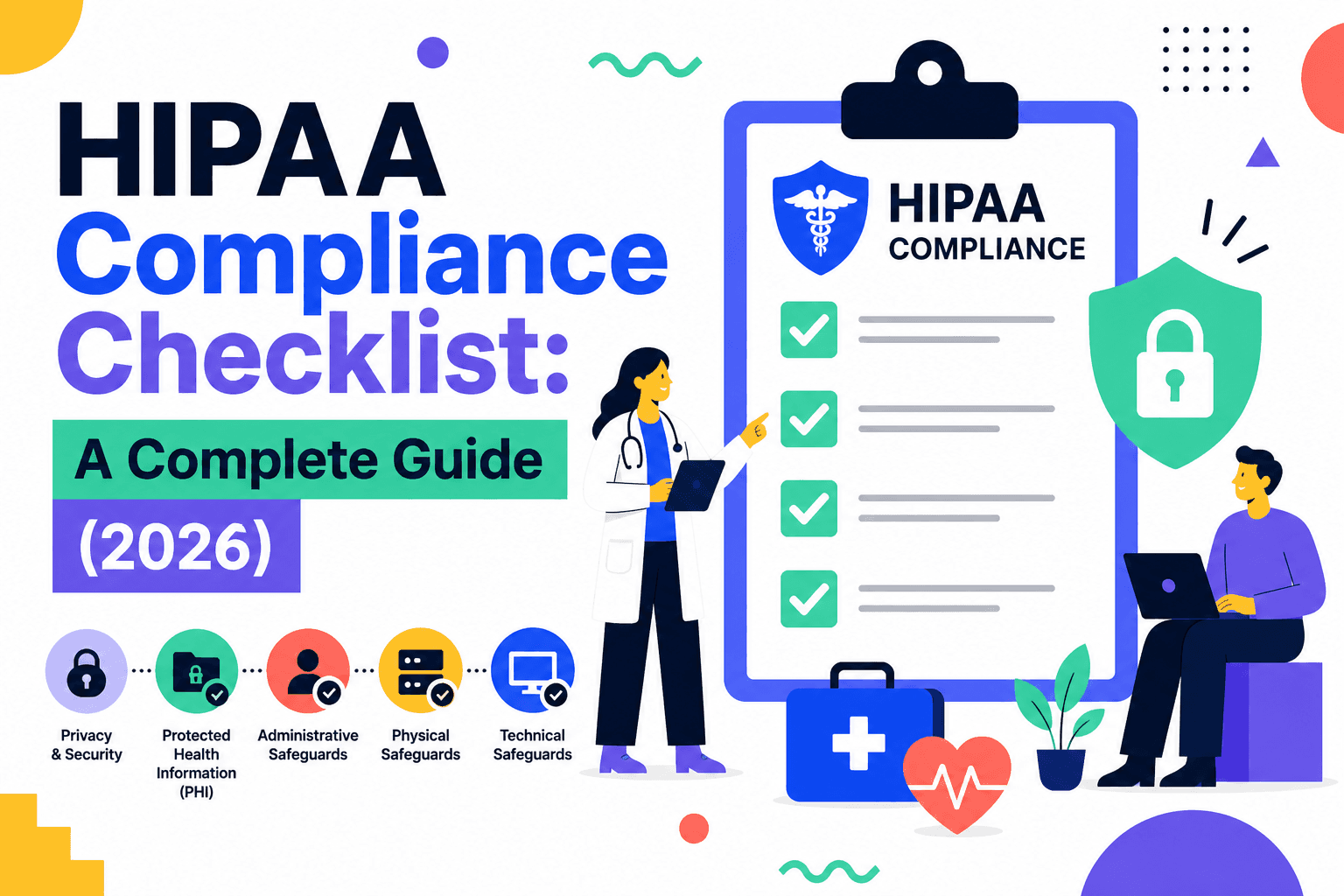
HIPAA Compliance Checklist (2026)
Below is a structured checklist aligned with HIPAA Security Rule standards. It is designed to guide your implementation and documentation efforts effectively.
Area | Key Actions | Evidence Expected |
Risk Analysis | Identify system vulnerabilities and threats | Formal risk register and assessment report |
Access Control | Implement RBAC and MFA | Access control policies, system configurations, and access logs |
Training | Conduct annual role-based training | Training records with completion tracking and attestations |
1. Define Scope & PHI Inventory
Identify all systems that create, receive, maintain, or transmit PHI, including internal systems and third-party vendors. Organizations should produce a comprehensive data inventory and system classification to clearly define audit scope boundaries.
2. Perform Risk Analysis (Required)
HIPAA requires organizations to perform a risk analysis under the Security Rule. You should include threat identification, vulnerability analysis, and an evaluation of both the likelihood and potential impact of adverse events. The expected output is a documented risk assessment report, which serves as the foundation for your subsequent security decisions.
3. Administrative Safeguards
Administrative safeguards establish the governance foundation for your compliance program. Focus on developing formal policies and procedures, assigning security responsibility to a designated officer, managing workforce security, and creating contingency planning documents. These policies dictate how your organization manages compliance on a daily basis.
4. Technical Safeguards
Technical safeguards are designed to protect electronic protected health information (ePHI) within systems. Organizations are expected to implement reasonable and appropriate technical safeguards, such as access controls, encryption of data at rest and in transit, audit logging, and data integrity mechanisms. These safeguards help reduce the risk of unauthorized access or modification of patient data.
5. Physical Safeguards
Physical safeguards protect your physical locations, hardware, and mobile devices. This includes facility access controls, appropriate workstation security policies, and device and media controls to prevent unauthorized physical access. Even for remote teams, you must document how laptops and mobile devices are secured and managed.
6. Business Associate Management
If you work with third parties that handle PHI on your behalf, you must manage that relationship formally. Execute Business Associate Agreements (BAAs), perform thorough vendor due diligence, and monitor third-party risk on an ongoing basis. Maintain executed Business Associate Agreements (BAAs) for all applicable vendors.
7. Documentation & Record Retention
Maintain highly organized records of your policies, procedures, and risk assessments. HIPAA typically requires you to retain related compliance documentation for a minimum of six years from the date of its creation or when it was last in effect. Centralized documentation prevents a chaotic scramble during a regulatory audit.
8. Incident Response & Breach Notification
Establish clear incident detection procedures and breach assessment criteria. Your response plan should outline exact notification timelines, without unreasonable delay and no later than 60 days, to meet regulatory obligations if an incident occurs. This allows your team to act decisively during a security event, rather than debating how to respond.
9. Workforce Training & Awareness
Employees play a critical role in preventing data exposure. Provide role-based training upon onboarding and conduct ongoing security awareness training, including annual refreshers. Training records provide evidence of workforce awareness and participation in data protection practices.
10. Continuous Monitoring & Internal Audits
Compliance is an operational priority that requires attention on an ongoing basis. Implement routine monitoring of logs, conduct periodic reviews of policies, and perform internal audits and readiness assessments to detect gaps before they escalate. Continuous monitoring is meant to identify, in a timely fashion, gaps in controls and other anomalies.
What Auditors Typically Look For
During audits or regulatory reviews, keep in mind that auditors value real proof more than good intentions. Instead of just saying how their controls work, organizations are expected to show how they work in practice. Risk analysis documents, access control logs, training records, and incident response evidence are all common audit artifacts.
Auditors typically seek evidence of the complete implementation and active usage of controls. If there is a policy but no technical log to back it up, it could be called a control deficiency during an assessment.
HIPAA Checklist PDF to Download
Download a structured checklist to support alignment with HIPAA requirements, including risk analysis, safeguards, and documentation practices.
How Roz Supports Audit and Compliance Engagements
Roz is an AI-native engagement and audit-delivery platform designed to support CPA firms and advisory teams.
With Roz, teams can:
Centralize documentation in client-specific workspaces
Organize evidence with traceability across all engagement materials
Extract controls from uploaded policies and procedures
Highlight potential documentation gaps through structured analysis
Core capabilities include:
AI-assisted draft workpapers with full audit trails and source links
First-pass control testing support
Questionnaire assistance using source-linked documentation
Roz does not replace auditors or certification bodies. It supports audit readiness workflows by structuring documentation and assisting with first-pass analysis, which helps reduce manual effort across engagements.
Conclusion
HIPAA is an ongoing compliance program, not a one-time project. Maintaining strong governance and clear documentation is often more important than simply acquiring new software tools.
Start with a structured checklist and iterate based on your organization's unique risk profile. By formalizing your approach to HIPAA, you can better protect patient data, build trust with covered entities, and better prepare for regulatory reviews and assessments.
Frequently Asked Questions
1. Is HIPAA compliance mandatory?
Yes, HIPAA compliance is a legal requirement for covered entities and business associates, including any subcontractors that manage protected health information (PHI).
2. Does HIPAA require certification?
No. There is no certification process for HIPAA compliance. There is a requirement to comply with the Privacy, Security, and Breach Notification Rules. Compliance is demonstrated through documented policies, procedures, and evidence, while enforcement is carried out by regulators such as the Office for Civil Rights (OCR).
3. What is the minimum retention period for HIPAA documentation?
HIPAA requires organizations to retain policies, procedures, and related documentation for at least six years from the date of creation or the date last in effect, whichever is later.
4. What happens if a vendor refuses to sign a BAA?
If the vendor is managing PHI for you and is not operating with an executed Business Associate Agreement (BAA), then you are likely to be in non-compliance with HIPAA. In such a case, your organization needs to change the vendor, or the vendor is not allowed to create, receive, maintain, or transmit PHI.