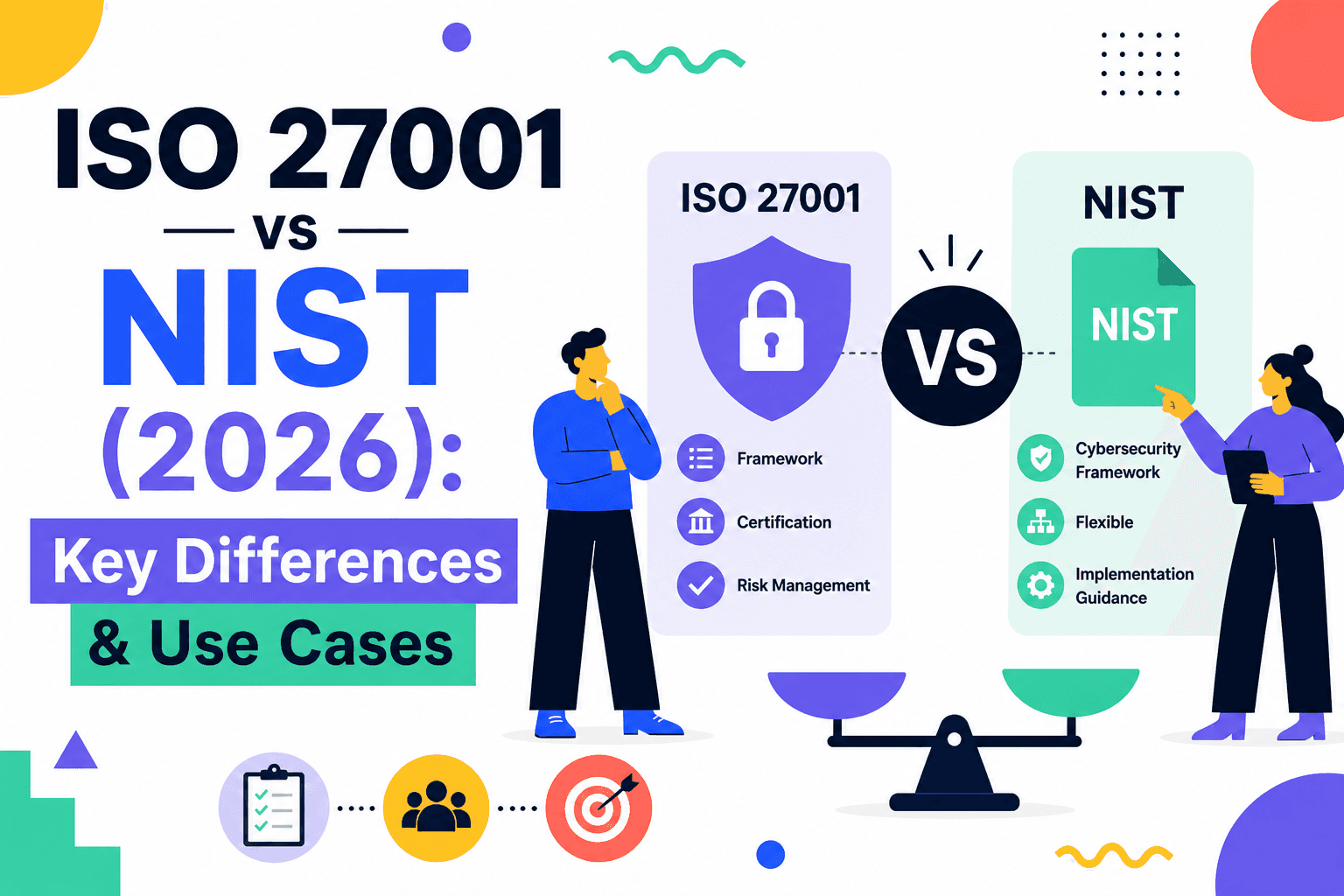
Choosing the right cybersecurity compliance approach can be complex, particularly given the number of standards and frameworks available. ISO 27001 is an internationally recognized standard that requires an external audit for certification, while the NIST Cybersecurity Framework (CSF) is a voluntary set of guidelines designed to help you manage cybersecurity risk.
The confusion usually starts when people use "standard" and "framework" interchangeably. During an audit, organizations are assessed against a standard that defines a set of requirements. A framework provides structured guidance that organizations can adapt to their specific maturity level.
In this article, we will compare these two approaches across their structure, certification requirements, costs, and primary use cases.
As we move through 2026, understanding this distinction is important. Organizations are finalizing their transitions to the ISO 27001:2022 update while simultaneously adopting the NIST CSF 2.0, which recently added "Govern" as a foundational function.
What Is ISO/IEC 27001?
ISO/IEC 27001 is an international standard that defines requirements for establishing, implementing, maintaining, and continually improving an Information Security Management System (ISMS).
The standard has two main parts:
Clauses 4–10: These define the requirements for managing information security risks, including how to identify, assess, and treat those risks.
Annex A: A catalog of 93 security controls (ISO 27001:2022). However, you are not required to implement all controls. Instead, you implement only those controls relevant to the risks you have and justify them in the Statement of Applicability (SoA).
ISO 27001 is based on continuous improvement and a risk-based approach. This approach is known to most organizations as the Plan-Do-Check-Act (PDCA) cycle. Organizations are required to undergo an audit from a third-party accredited to provide ISO 27001 certification. Certification demonstrates that an organization has implemented a structured approach to managing information security risks.
What Is NIST Cybersecurity Framework?
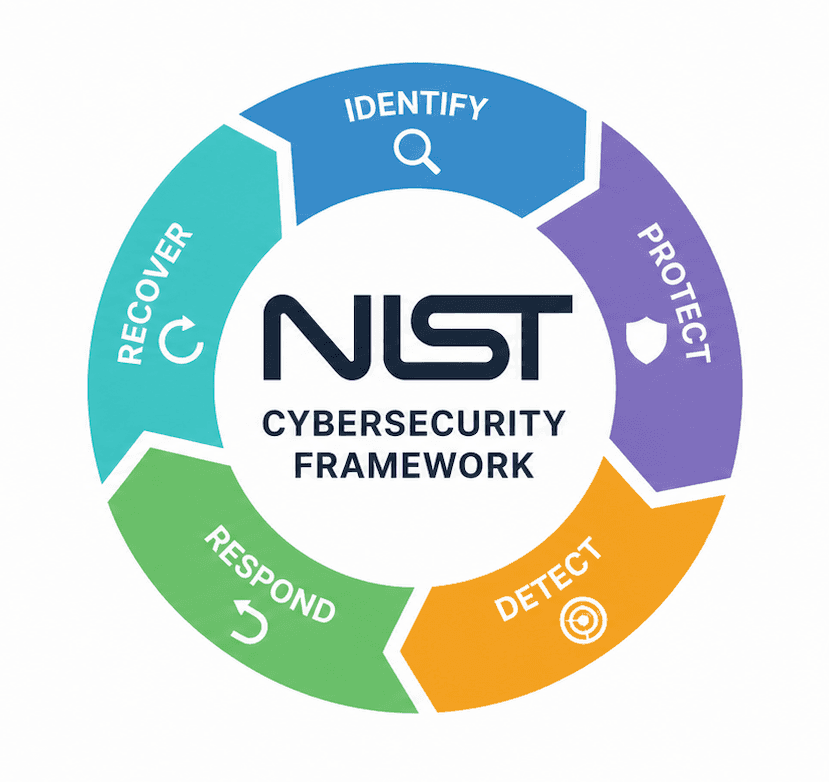
The NIST Cybersecurity Framework is a risk-based cybersecurity framework developed by the U.S. National Institute of Standards and Technology.
The framework is divided into 6 core functions:
Govern: Understanding your organization's risk management strategy and policies.
Identify: Understanding the people, systems, data, and assets that need protection.
Protect: Implementing safeguards to ensure delivery of critical services.
Detect: Identifying the occurrence of a cybersecurity event.
Respond: Taking action regarding a detected cybersecurity incident.
Recover: Restoring any capabilities or services that were impaired.
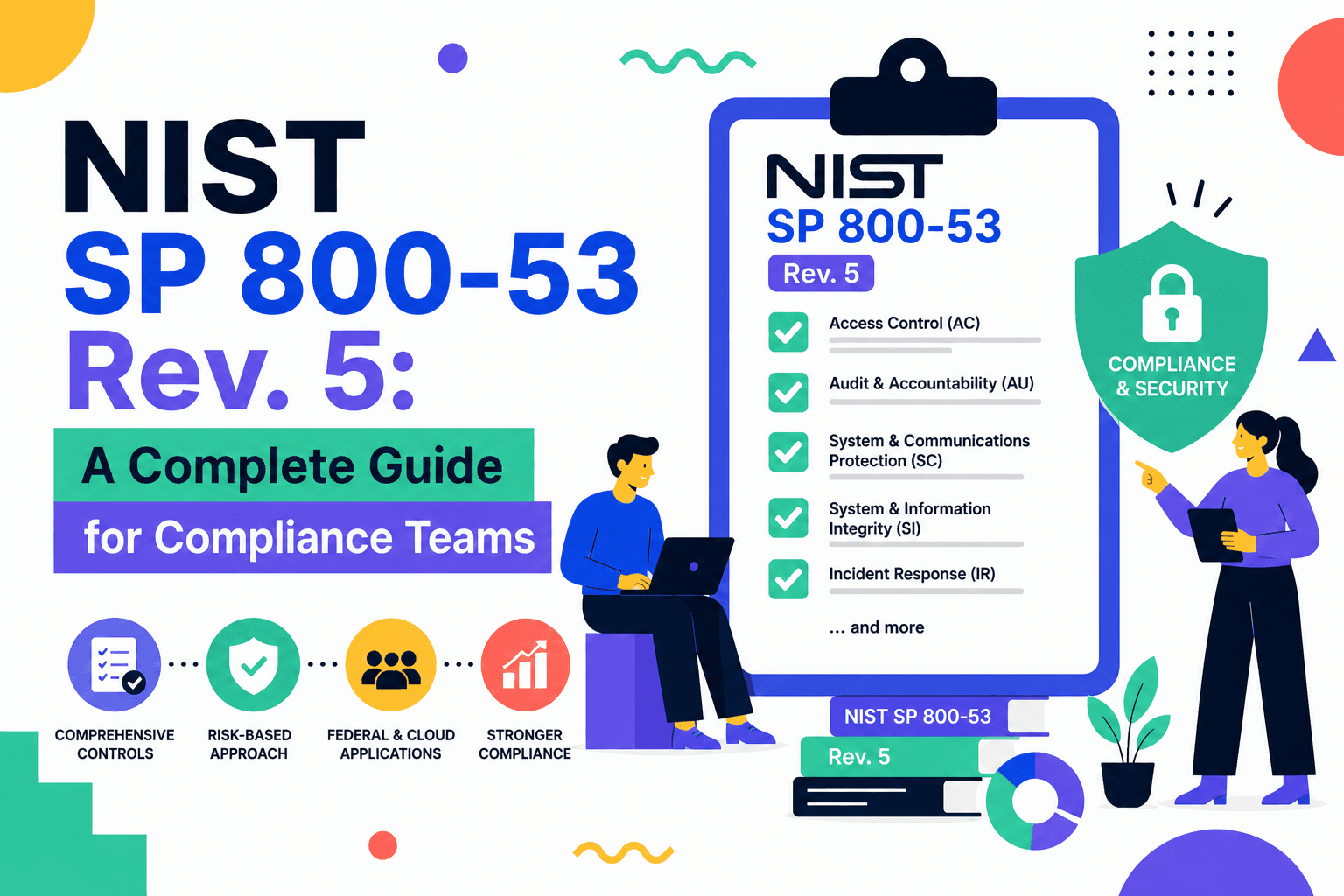
The CSF provides broad categories for cybersecurity risk management, but most organizations look to NIST SP 800-53 for technical details. NIST SP 800-53 provides a comprehensive catalog of security and privacy controls. In contrast to ISO 27001, there is no NIST certification. The framework is designed to be adaptable to varying levels of guidance based on the organization’s risk approach, priorities, and resources.
Why Compare ISO 27001 vs NIST in 2026?
Buyer expectations for security validations are increasing rapidly. When you respond to enterprise procurement requests or vendor security reviews, buyers expect clear alignment with recognized guidelines.
Additionally, multi-framework environments are becoming the norm. A major trend in 2026 involves organizations mapping NIST CSF categories and NIST SP 800-53 controls to ISO 27001, and subsequently to SOC 2, to satisfy varying customer demands without duplicating work. Manual tracking of these mappings can become complex and resource-intensive, particularly when managed through spreadsheets.
ISO 27001 vs NIST: Key Differences
Criteria | ISO 27001 | NIST |
Type | Standard | Framework |
Certification | Yes (Third-party audit) | No |
Structure | Clauses + Controls | Functions + Categories |
Flexibility | Moderate | High |
Adoption | Global | US-origin |
Use case | Compliance & trust | Risk management |
Certification vs Framework: What It Means in Practice
The difference between a certifiable standard and a voluntary framework significantly influences your day-to-day compliance activities.
With ISO 27001, you are preparing for an external audit. This requires strict evidence gathering, maintaining an audit trail, and formal documentation. You must prove to an auditor that your ISMS is functioning exactly as documented.
With NIST, you are typically performing a self-assessment or internal maturity benchmarking. You measure your current security posture against your target profile to identify gaps.
Keep in mind that a certification does not equal better security, just as a framework does not mean weaker controls. Certification primarily serves as an external communication tool to build trust with buyers.
Structural Differences: Controls vs Functions
ISO 27001 is heavily control-driven. Your risk assessment directly dictates which Annex A controls you apply.
NIST is outcome-driven. It focuses on achieving specific functional outcomes (like "Protect" or "Respond") rather than dictating a mandatory checklist.
However, these approaches complement each other. Many ISO 27001 controls align closely with NIST categories. Understanding this mapping concept can significantly reduce duplicate effort if you decide to adopt both methodologies over time.
Cost, Effort, and Resource Requirements
Depending on what you choose, you will approach the budgeting process quite differently for these two initiatives.
ISO 27001 Costs:
Costs include Stage 1 and Stage 2 certification audits, along with ongoing surveillance audits.
Annual surveillance audit costs
Costs of documentation structure and allocation of internal resources.
NIST Costs:
No certification or external audit fees.
Costs vary based on implementation scope, organizational maturity, and the extent of framework adoption.
Given the organization size, scope, and complexity, the costs will naturally vary.
Global vs US Adoption Considerations
Existing geography and the market you target will greatly influence how you select your framework.
If you provide SaaS to a global market or sell to large enterprises in Europe, you will find that ISO 27001 is the most widely accepted and recognized international standard.
If your business primarily operates in the US federal landscape or you plan to sell to US government contractors, you will find that NIST is often expected and, in some cases, required by regulation (particularly NIST SP 800-53 or NIST SP 800-171). Vendor questionnaires will typically refer to both frameworks, although the requirements and obligations differ depending on the jurisdiction.
ISO 27001 vs NIST: Which Should You Choose?
Organizations typically base this decision on their business objectives.
Choose ISO 27001 if:
You need formal certification to satisfy customer procurement requirements.
You operate internationally.
You require a high degree of audit defensibility.
Choose NIST if:
You are actively building a foundational security program.
You need flexibility to implement controls gradually.
You do not have an immediate business requirement for third-party certification.
Choose both if:
You want internal maturity paired with external certification.
You serve both enterprise commercial markets and regulated US sectors.
Can You Use ISO 27001 and NIST Together?
Yes. Using both together is an increasingly common approach.
A practical workflow involves using the NIST CSF to conduct your initial gap assessment and build your security maturity. Once your foundational practices are established, you can map those existing controls to ISO 27001 Annex A. Finally, you formalize your management processes (the ISMS) to achieve ISO 27001 certification.
This control mapping strategy reduces duplication and may support audit readiness.
Common Mistakes to Avoid
When navigating these methodologies, watch out for these frequent missteps:
Treating NIST as a certification: You cannot be "NIST certified" by an accredited body.
Assuming ISO guarantees security: ISO 27001 checks your management system, but no standard stops all breaches.
Ignoring control mapping: Running two separate compliance programs makes unnecessary silos.
Over-engineering documentation: Make sure your policies are useful and in line with how you really do things.
Misaligning scope: Failing to clearly define the boundary of your ISMS can make audits needlessly complex.
How Roz Supports ISO 27001 and NIST Engagements
Navigating multiple frameworks can quickly overwhelm advisory teams. Roz is an AI-native engagement and audit-delivery platform that helps teams manage these workflows more effectively.
Centralized evidence workspace: Keep client documentation, policies, and procedures in one secure, structured location.
AI-assisted draft workpapers: Generate draft workpapers from firm templates with audit trails linking back to source files.
Control extraction and mapping: Extract controls from uploaded policies and support structured mapping for comparison against framework requirements.
Roz may help streamline documentation reviews during gap analysis and supports teams by providing visibility into risk and control matrices. It assists with audit preparation, allowing teams to focus on higher-value advisory work rather than manual documentation tasks.
Conclusion
Selecting between ISO 27001 and the NIST Cybersecurity Framework is a matter of aligning your compliance strategy with your business objectives. ISO 27001 offers certification and structured governance, making it ideal for organizations that need to prove their posture to external stakeholders. NIST provides flexibility and outcome-based risk management, which is well-suited for teams building internal maturity.
Evaluate your current organizational maturity, look closely at your buyer requirements, and choose the path that supports your growth. Compliance is a strategic opportunity to build trust in your market.