As businesses expand, implementing a structured approach to quality and trust becomes increasingly important. Maintaining operational consistency with the standards establishes the practice as a norm for the business. This is where a recognized framework can help.
Achieving ISO 9001 certification demonstrates your commitment to quality and customer satisfaction. It shows clients, partners, and regulators that you have established clear processes to deliver consistent products and services. Many companies pursue this certification to qualify for new vendor contracts, improve internal efficiency, and build long-term trust in the market.
In this article, I will cover the essential aspects of ISO 9001 certification, including the core requirements, expected costs, implementation process, timelines, and common challenges.
What Is ISO 9001 Certification?
ISO 9001 is an international standard that defines requirements for a Quality Management System (QMS). A QMS is a structured approach to managing processes, responsibilities, and documented information that will help a company achieve and consistently provide products and services that meet both customer and regulatory requirements.
ISO 9001:2015 is the current version of the standard and focuses on risk-based reasoning, accountability for leadership roles, and a strong emphasis on continuous improvement. Instead of telling companies how to run practices, the ISO 9001 standard requires companies to establish, implement, maintain, and improve the most important company processes. Because of the many variations, each company can focus on standards that best fit their needs.
Companies seeking to demonstrate their systematic approach to quality management utilize ISO 9001.
Who Should Consider ISO 9001 Certification?
Because the standard is adaptable, it can be applied across industries. Some organizational types that usually benefit from refining their quality processes comprise:
Manufacturing companies: Looking to reduce defects, standardize production workflows, and reduce operational waste.
SaaS companies: Looking to improve their development processes, their change management processes, and consistency in their customer support.
Service providers: Looking to provide more consistent and equally high-quality services and to standardize their processes.
Startups entering enterprise markets: Needing to demonstrate operational capability in vendor risk assessments and procurement reviews.
Government contractors: Where obtaining ISO 9001 certification can improve your chances of getting public contracts.
Growing companies: Looking to expand their customer base quickly and still maintain consistency and quality in their operations across different teams and locations.
Key Benefits of ISO 9001 Certification
Setting up a QMS comes with several valuable benefits to your entire company.
Operational Benefits
A QMS improves the flow and structure of your company processes so that everyone can remain on the same page. Documenting a procedure makes it easier to carry out and reduces the possibility of missteps. Good documentation reduces the number of informal procedures that employees use to educate one another by filling out the gaps of a system, which decreases the time it takes to train a new hire.
Business Benefits
If your company prioritizes earning and maintaining the trust of your customers, then earning the ISO 9001 certification will greatly benefit your company. International standards as they pertain to QMS systems and certification will greatly improve customers’ and partners’ perception of your company. For that reason, it will help qualify your business as a more competitive option.
Governance Benefits
Creating a QMS system structures quality management strategies and allows management and higher-level governance to become more active. A risk-based approach enables companies to acknowledge concerns about the quality of goods before problems arise. This makes it easier to improve on quality controls as the level of complexity and scope of the business expands.
Understanding the ISO 9001 Clauses
To become ISO 9001 certified, there are requirements for Clauses 4 to 10. It would be helpful to consider these clauses as the foundation of your quality management system, or QMS, and the framework for how to develop, manage, and enhance your quality procedures.
Clause 4 - Context of the Company: First, you will need to get to know your environment and all the internal and external factors and interested parties that will influence your QMS. Subsequently, you will define the boundaries and the context of your QMS and its processes.
Clause 5 - Leadership: Management's engagement is critical. Leadership must demonstrate their engagement by establishing a quality policy, clarifying responsibilities, and integrating the QMS into the routine business activities of the company. Top management holds the most accountability, and this is where it starts.
Clause 6 - Planning: This clause focuses on the future. This is where you are going to establish quality goals that can be measured and come up with plans to address possible threats and opportunities. It encourages a proactive, risk-based approach to ensure that you are ready for anything.
Clause 7 - Support: You can't build a great QMS without a strong support system. In this clause, you will cover the necessary elements required for success, such as adequate and competent personnel, appropriate infrastructure, effective communication, and a controlled system of documented information.
Clause 8 - Operation: This clause focuses on operational execution. Clause 8 is about the inner workings of your business, which include creating and delivering goods and services to customers. This clause focuses on how to meet customer needs, manage services provided by a third party, and monitor how the business operates to achieve desired results.
Clause 9 - Performance Evaluation: How do you know if your QMS is working? This clause focuses on the monitoring, measuring, and evaluating of the QMS. This includes monitoring, internal audits, and management review.
Clause 10 - Improvement: The goal is to always get better. This clause focuses on how to deal with problems, make sure they don't happen again, and keep improving your QMS.
Understanding the Cost of ISO 9001 Certification
The ISO 9001 certification is a multi-step process for every company. Budgeting for each part is a challenge since implementation approaches vary across companies.
Key Factors Affecting Cost
Several factors influence the total cost of certification:
Company Size: More employees generally means longer audits.
Certification Scope: More audits are required if you have multiple sites to get ISO 9001 certified.
Certification Body Fees: Every accredited body will have different structures and dimensions of pricing.
QMS Maturity: If you already have well-documented processes, you'll likely spend less on preparation.
External Support: Consultants may assist with implementation, which can impact total cost depending on scope.
Internal Resources: Companies with dedicated internal teams may reduce reliance on external consultants.
Typical Cost Range
Though there are costs that are highly variable, most companies will see the following general ranges:
Small companies (1–25 employees): Approximately $3,000–$10,000+, depending on readiness and scope of certification.
Mid-size companies (26–100 employees): Approximately $8,000–$20,000+, depending on process complexity and the scope of the audit.
Large enterprises (100+ employees): $15,000 and above; costs continue to increase with the number of sites and levels of complexity of the operations.
Important Note: Remember that ISO 9001 certification is not a one-time thing. Consider the following three-year certification cycle:
An initial certification audit
Annual surveillance audits
A recertification audit at the end of the three years
Certification requires ongoing surveillance audits and periodic recertification to keep your quality management system up to date. It's advisable to consider these recurring costs in your long-term budget.
ISO 9001 Certification Process
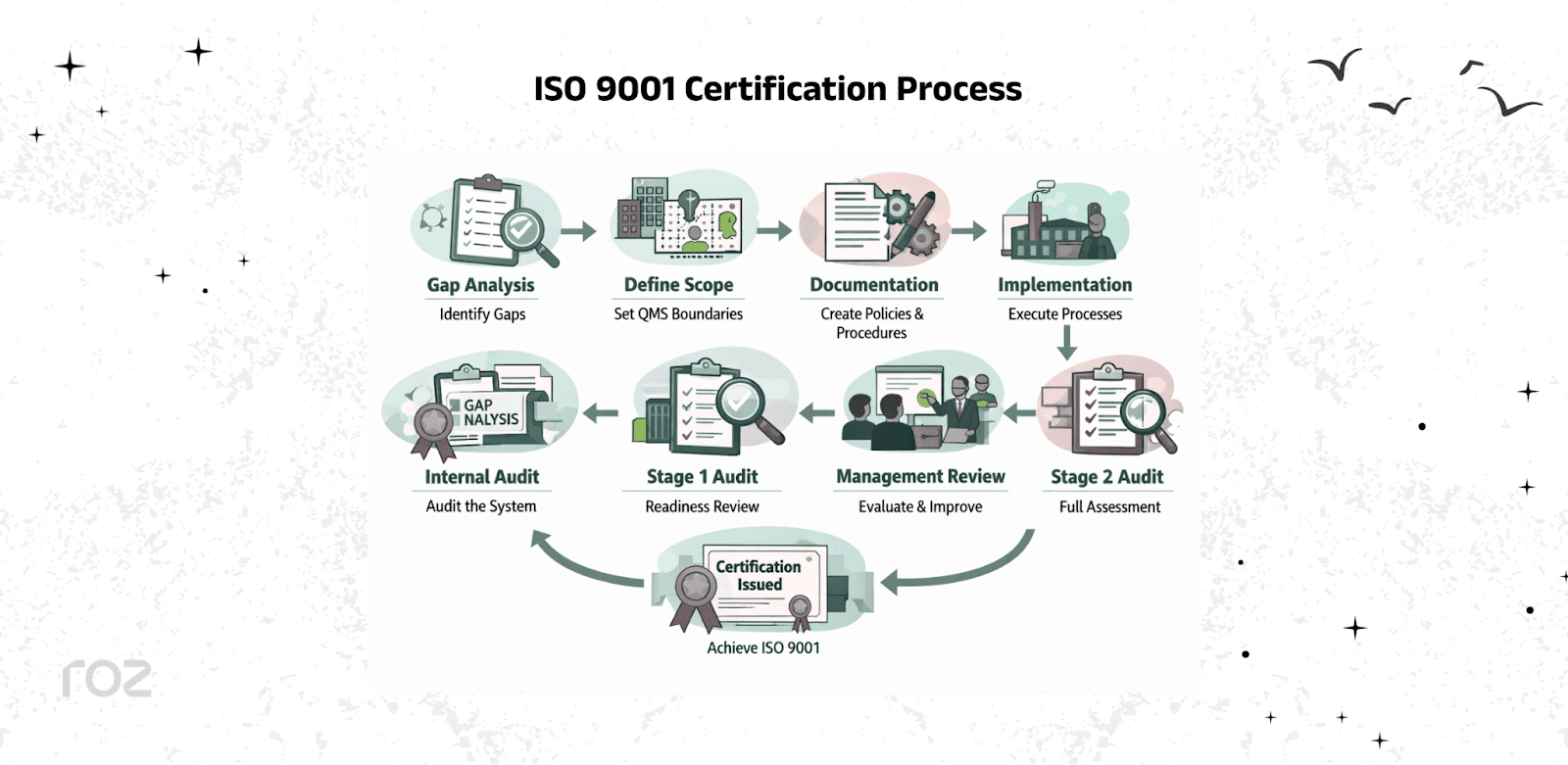
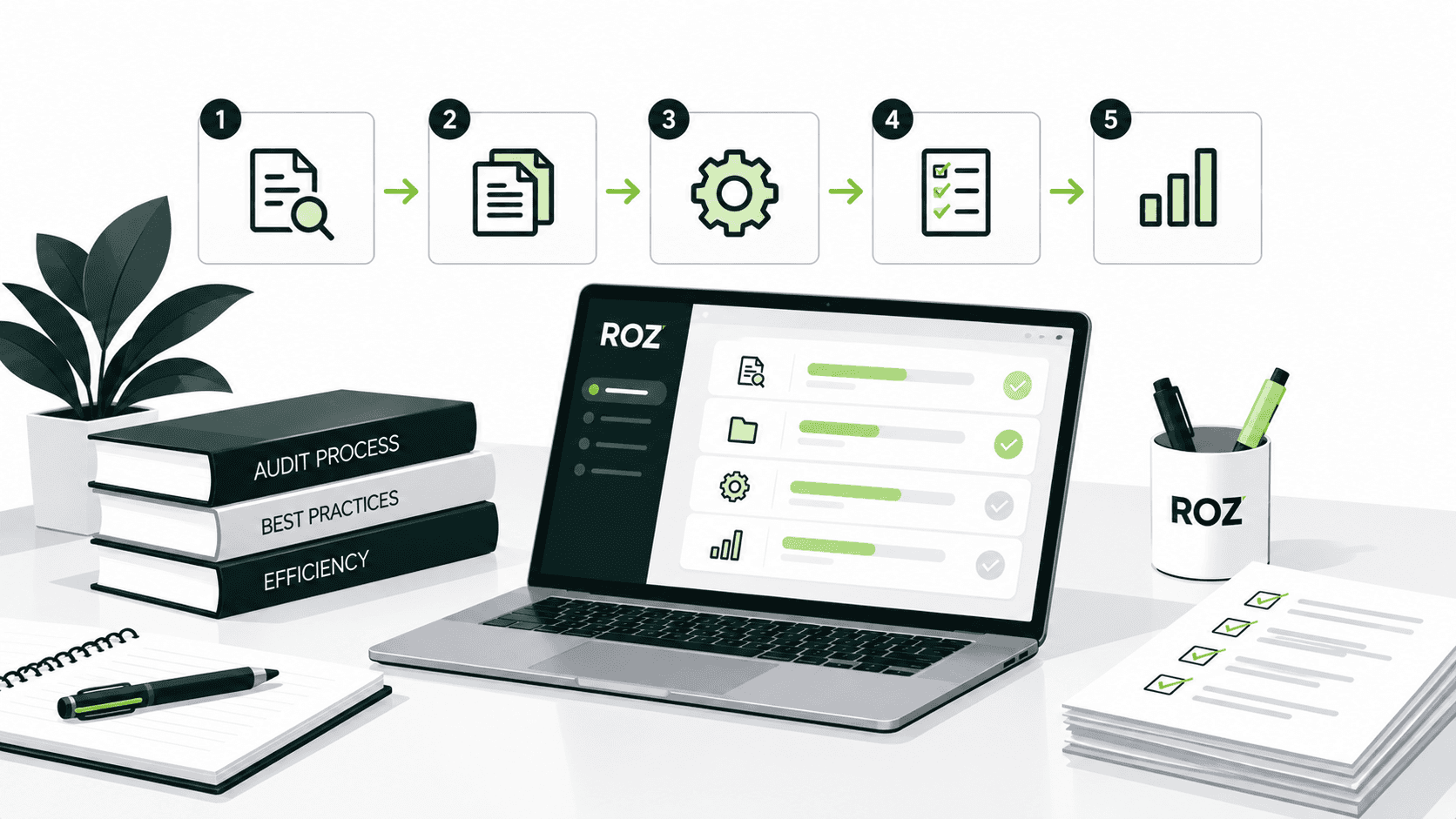
Getting your ISO 9001 certification involves a few key steps. Here’s a brief overview of the steps you will take to become certified.
Gap Analysis: First, you will review your company processes and benchmark them against the ISO 9001 standards. This will assist you in pinpointing the necessary improvements.
Define Your Scope: Determine which areas of your company will be part of the QMS. Your scope must be in line with your company’s objectives and organizational boundaries
Create Documentation: Next, you will be required to outline the quality objectives, quality policy, and the procedures. Here you will also need to outline the core processes and assign roles.
Implementation: You are now ready to start putting all processes into practice. Ensure all team members are clear about their responsibilities within the QMS.
Internal Audit: Before the official audit, you will need to conduct your own audit to verify a few things: Is the QMS working, and is it effective and compliant with ISO 9001?
Management Review: Your leadership team will need to review the QMS to see what gaps exist with the audit. The team will also assess the gaps to identify improvement opportunities.
Stage 1 Audit: An external auditor from a certification body will look at your documentation to see if you are prepared for the major audit.
Stage 2 Audit: The certification body performs a thorough audit to verify the effective implementation and operation of your QMS.
Certification: Once you resolve the problems identified in the audit, the certification body issues an ISO 9001 certification.
How Long Does ISO 9001 Certification Take?
The length of the ISO 9001 certification process may vary based on the complexity of its scope, the company's maturity, and the availability of resources allocated to it. If a company already has well-established processes and documentation for their quality management systems, they may take less time to complete their certification. On the other hand, companies without established documentation may require more time to complete certification.
Typical timelines that companies can expect include:
Small companies: Approximately 2 to 4 months
Mid-size companies: Approximately 3 to 6 months
Large enterprises: Approximately 6 to 12 months
How to Choose a Certification Body
Choosing an accredited certification body is a key step in the ISO 9001 certification process. These bodies must remain independent and impartial when conducting audits and issuing certifications.
In most cases, companies will evaluate certifying bodies based on:
Accreditation status
Industry experience
Audit methodology
Reputation and global recognition
In the United States, the United Kingdom, and India, the most well-known bodies for accreditation are ANAB (US), UKAS (UK), and NABCB (India), respectively.
It is important for companies to consider the experience of the certification body within the sector of the industry in which the company is operating. Having sectoral experience is critical to having the proper context for the audits.
How Roz Supports ISO 9001 Engagements
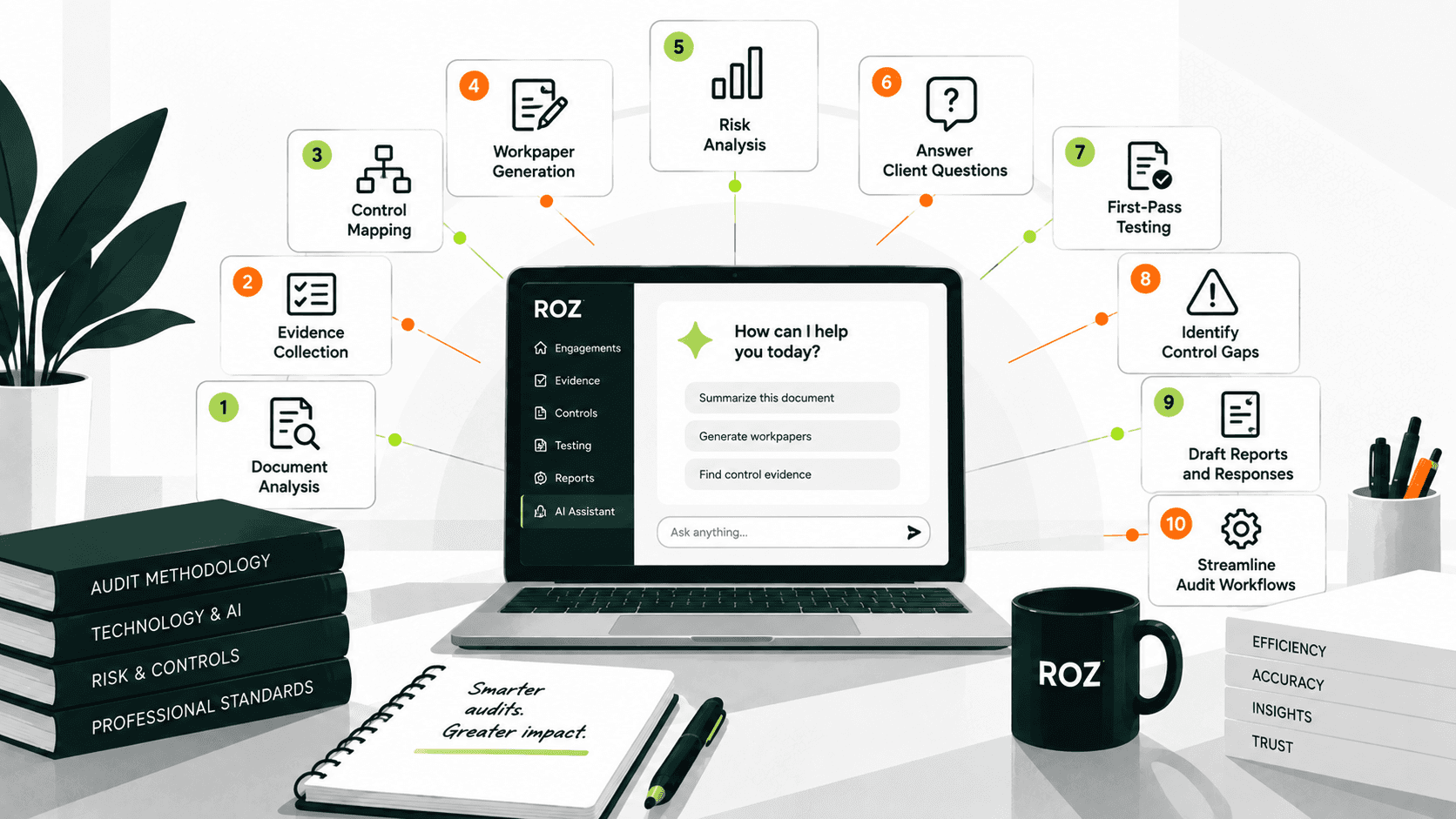
Managing the documentation required for a QMS can be complex and time-consuming. Roz supports ISO 9001–related engagements by providing a structured environment for documentation review and audit preparation. Designed for CPA and advisory teams, we help streamline documentation-heavy quality engagements.
Think of Roz as an intelligent enterprise data room. It acts as a central hub where advisory teams can:
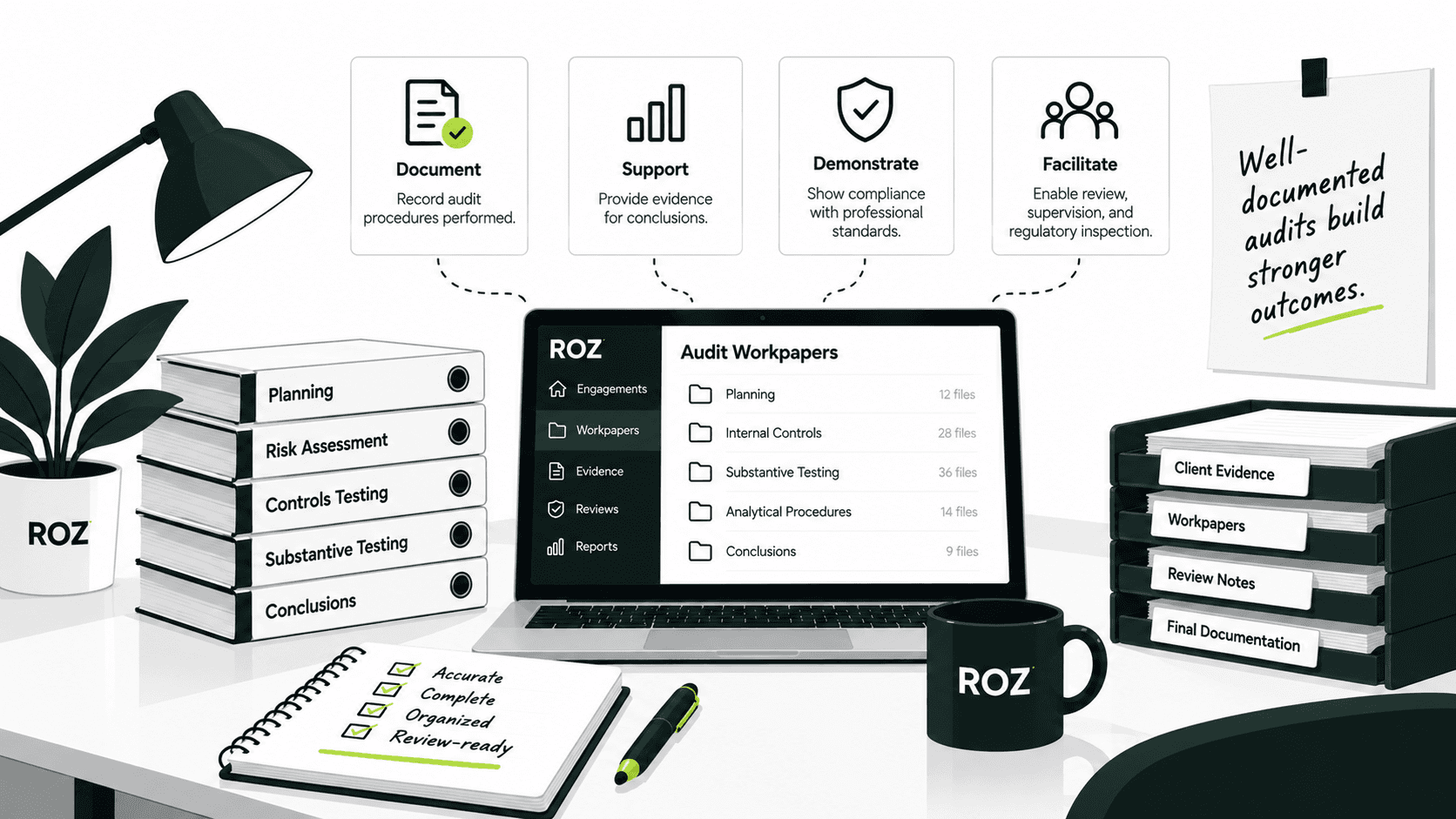
Organize documentation and evidence: Create centralized client workspaces to keep everything in one place.
Generate draft workpapers: Use your firm's templates to create drafts with full audit trails and source traceability.
Review documentation: Easily check documents and highlight potential gaps for readiness assessments.
Maintain traceability: Keep a clear connection between all engagement materials and their outputs.
Our tool does not replace certification bodies or auditors. Instead, it helps advisory teams by organizing documents and making the delivery of ISO 9001 easier, which reduces manual work and improves initial analysis.
Common ISO 9001 Certification Challenges
Companies often face a few hurdles when implementing ISO 9001. A major challenge is the documentation effort, especially when managing it manually. Change management can also be an issue, as employees might resist new workflows. Resource constraints can stretch smaller teams thin, while maintaining continuous improvement after certification requires sustained focus.
You can overcome these challenges with a few key strategies:
Strong leadership involvement: If executives support the project, the rest of the employees are likely to support it as well.
Define a clear scope: This will help maintain project manageability and ensure its completion.
Early internal audits: Early audits will help to mitigate the larger problems that could arise.
Conclusion
For many companies, ISO 9001 certification indicates maturity in their QMS. Certification can support improvements in the business's operational maturity in the marketplace. Continuous improvement within the QMS is key to realizing long-term benefits.
I hope this article has helped you understand ISO 9001 certification, including requirements, cost, and process, so you can determine the best path forward for your company.