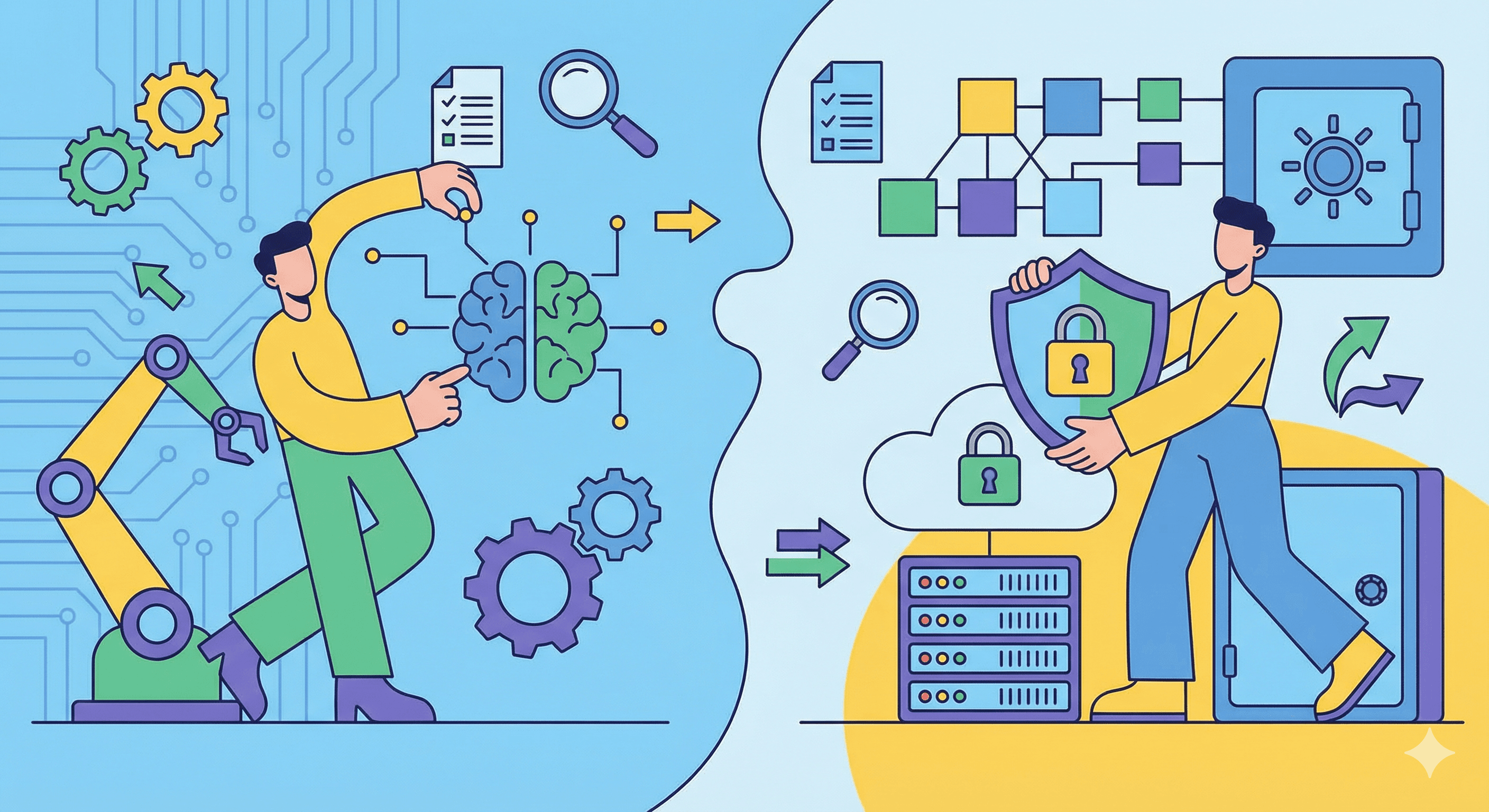
The adoption of artificial intelligence is increasing in all areas of business. Companies are using AI to improve efficiency, enhance data analytics, and develop more intelligent products. However, AI is also creating new challenges for the governance of algorithmic bias, data privacy issues, and opacity. These challenges can lead to decreased trust from stakeholders.
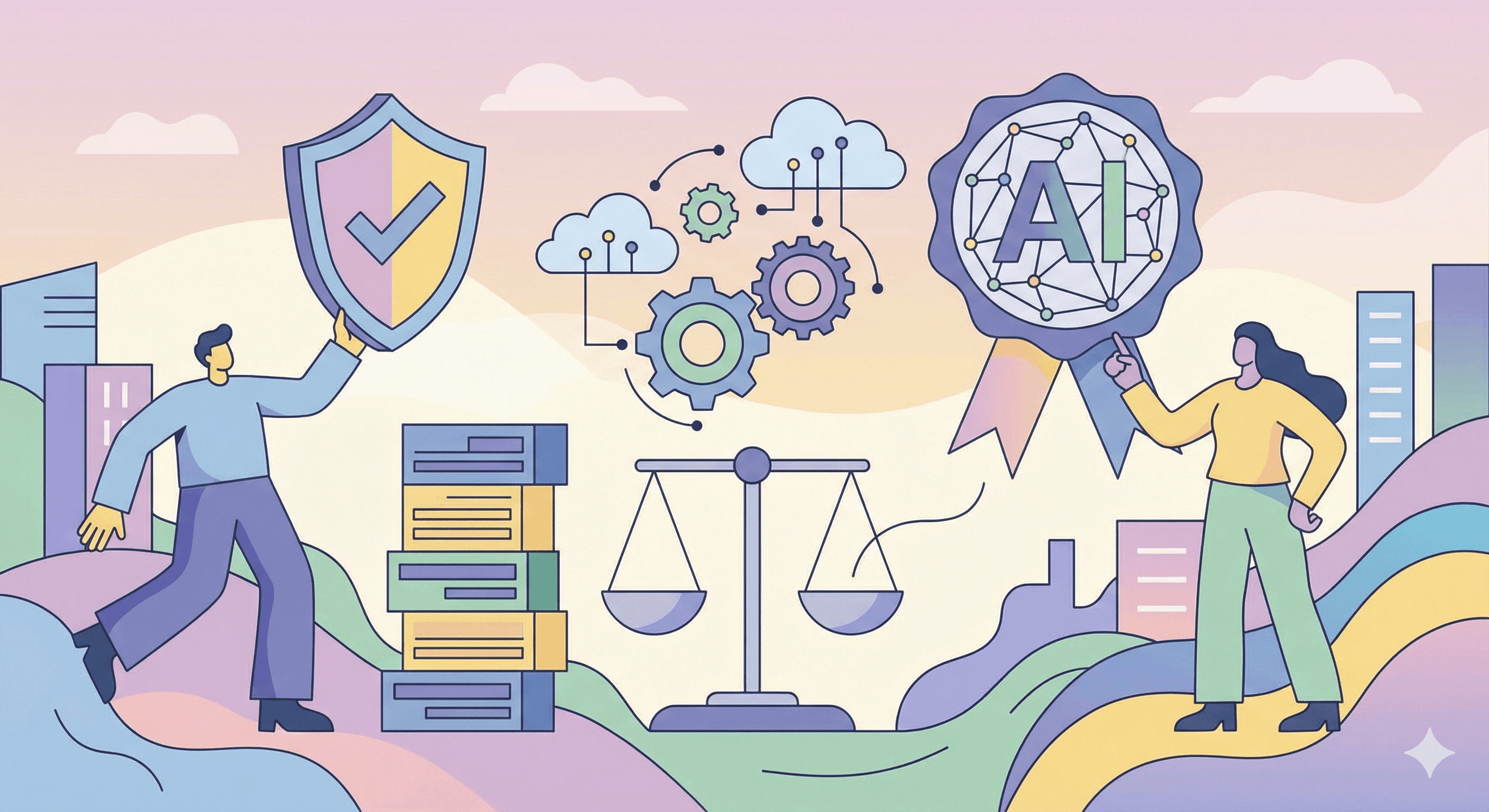
ISO/IEC 42001:2023 is one of the first international standards for Artificial Intelligence Management Systems (AIMS), providing a framework for organizations to address and manage AI governance risks, including regulatory and reputational considerations.
In this article, we will analyze the cost, duration, and process involved in implementing and obtaining ISO 42001 certification, with a focus on managing evolving AI governance risks.
What is ISO 42001 Certification?
ISO 42001 is an international standard that specifies the requirements for the establishment, implementation, maintenance, and continuous improvement of the Artificial Intelligence Management System (AIMS) of a company. It is a certifiable standard focused on AI governance, issued in December 2023. The standard focuses on the responsible development, deployment, and use of AI systems through governance, risk management, and oversight of the entire AI life cycle.
ISO 42001 focuses on the following specific areas:
AI governance and accountability
Ongoing/Continuous Risk Management
Responsible and Ethical Use of AI
Risk and governance transparency and explainability
AI systems life cycle management
An AI management system is a centralized governance framework for the organization that outlines the following:
AI life cycle governance encompasses the design, development, deployment, and retirement of the system.
The assignment of risk management and accountability.
The responsible use of AI in a transparent and understandable manner.
Who Needs ISO 42001 Certification?
Implementing an Artificial Intelligence Management System based on ISO 42001 can benefit many types of organizations.
AI Developers: Companies can pursue ISO 42001 certification to demonstrate AI governance controls, AI SaaS companies, and machine learning platform companies to have a governance system to manage AI-related risks.
Companies That Use AI: Financial technology, healthcare, and e-commerce companies that use AI tools for decision-making can implement ISO 42001 to manage risks associated with AI tools.
AI Service Providers: Companies that provide consulting, automation, and setup services for AI can use ISO 42001 to demonstrate that they have adequate management and control of the AI solutions offered to their clients.
Large companies: Companies that use AI to make predictions, automate processes, or assist in decision-making may adopt ISO 42001 for the sake of having uniform governance and control across all their divisions.
ISO 42001 Certification Requirements
To become ISO 42001 certified, companies need to create and manage an AIMS that fulfills the criteria of ISO/IEC 42001:2023. This includes the combination of management system controls and AI governance frameworks.
Core ISO 42001 Clauses
ISO 42001 follows the Plan-Do-Check-Act model, consistent with other ISO management system frameworks.
Context of the Organization (Clause 4): You must define the scope of your AI systems, identify internal and external stakeholders, and determine relevant risks.
Leadership (Clause 5): Your team must define the AI policy, allocate and assign roles and accountabilities to AI governance, and lead. It’s essential that the top management participates.
Planning (Clause 6): This requires the identification of the governance of AI and the risks and opportunities related to it, the establishment of quantifiable and measurable targets, and the formulation of actions to mitigate the risks.
Support (Clause 7): You must provide the necessary resources, equipment, documentation, training, and other means that the personnel require. This ensures that the AI governance policies are followed.
Operation (Clause 8): You must implement policies that govern the AI lifecycle, including its development, testing, deployment, and maintenance.
Performance Evaluation (Clause 9): This means ongoing governance of the AI systems and requires teams to conduct audits and to assess the effectiveness of the governance system.
Improvement (Clause 10): Each standard puts a premium on improvement. You will have to resolve the problems, modify your risk management, and improve your AI governance controls to a higher degree.
AI-Specific Requirements
Besides standard management controls, the ISO 42001 outlines controls pertaining to AI. These AI-specific controls address risks unique to artificial intelligence systems, including bias, transparency, and lifecycle governance. These controls complement traditional management system requirements and help organizations manage AI-specific risks more effectively.
You will implement controls such as:
AI risk assessments conducted at regular intervals.
Setting up bias and fairness controls.
Maintaining governance throughout the AI lifecycle.
Implementing human oversight.
Enforcing data governance.
ISO 42001 Controls and Framework Structure
ISO 42001 Annex A suggests certain safeguards that can assist in establishing a structured approach to AI governance and risk management. Let's break down what these controls cover.
Governance: These controls allow for accountability concerning the AI systems. This means these controls act as a playbook for accountability.
Risk Management: This control allows for the identification, evaluation, and continuous monitoring of the risks associated with the AI. This can be viewed as a continuous, ongoing safety check for the AI.
Data: These controls provide high-quality training data and minimize bias. More quality data increases the reliability of the AI.
Lifecycle: This control relates to the entire span of life of the AI system, including the design, development, and testing, as well as the deployment and monitoring activities that should be done on the system.
Third-Party: These controls are applicable to the implementation of external AI tools. They assist you in the risk evaluation and management of vendors.
Why Should You Get ISO 42001 Certified?
Implementing ISO 42001 offers several advantages for your business, from better risk management to smoother operations.
Build Trust and Win Deals: Certification shows you have strong AI governance, which helps build customer trust and gives you an edge in procurement evaluations.
Strengthen Risk Management: By implementing AI governance controls, you can better identify, manage, and oversee AI-related risks.
Stay Ahead of Regulations: ISO 42001 helps you prepare for new AI laws and align with changing governance standards.
Improve Operations: Standardizing your AI practices improves accountability, documentation, and teamwork across your organization.
ISO 42001 Certification Timeline
Implementation timelines vary based on organizational maturity, scope, and AI complexity. Many companies complete certification within 4-9 months. Companies starting from scratch may take up to 9-12 months, while companies with existing governance frameworks (like ISO 27001) may complete certification faster.
Typical Timeline
Company Type | Typical Timeline |
Small companies | 4-5 months |
Mid-size companies | 5-7 months |
Enterprise companies | 6-9 months |
Starting from scratch | 9-12 months |
Your timeline might change depending on how mature your compliance is, what AI systems are in scope, and how ready your documentation is. Roz helps teams organize documentation and support ISO 42001 audit preparation.
ISO 42001 Certification Process
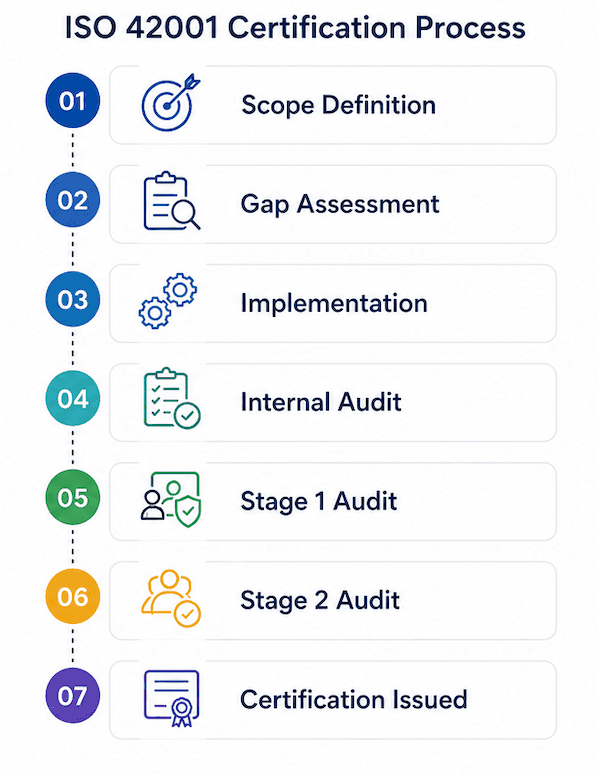
The ISO 42001 certification process typically follows a structured management system implementation and audit approach.
Scope Definition: Determine the AI systems, processes, datasets, and departments that will be included in the Artificial Intelligence Management System (AIMS)
Gap Assessment: Determine AI governance practices that already exist and how they align with the ISO 42001 standards and identify the gaps and areas for improvement.
Implementation: Create and implement policies, procedures, and controls to address the gaps.
Internal Audit: Conduct internal audits to evaluate readiness and identify any remaining non-conformities.
Stage 1 Audit: A certification body examines the submitted documents, and the Stage 1 audit evaluates the documentation and readiness of the AIMS in compliance with ISO 42001.
Stage 2 Audit: Determine if adequate operational controls are in place (and, if not, so they can be implemented and working as they should.)
Certification Issued: If the company qualifies for certification, it will be issued an ISO 42001 certification that will be valid for 3 years. During those three years, companies typically undergo annual surveillance audits to maintain certification.
ISO 42001 Certification Cost
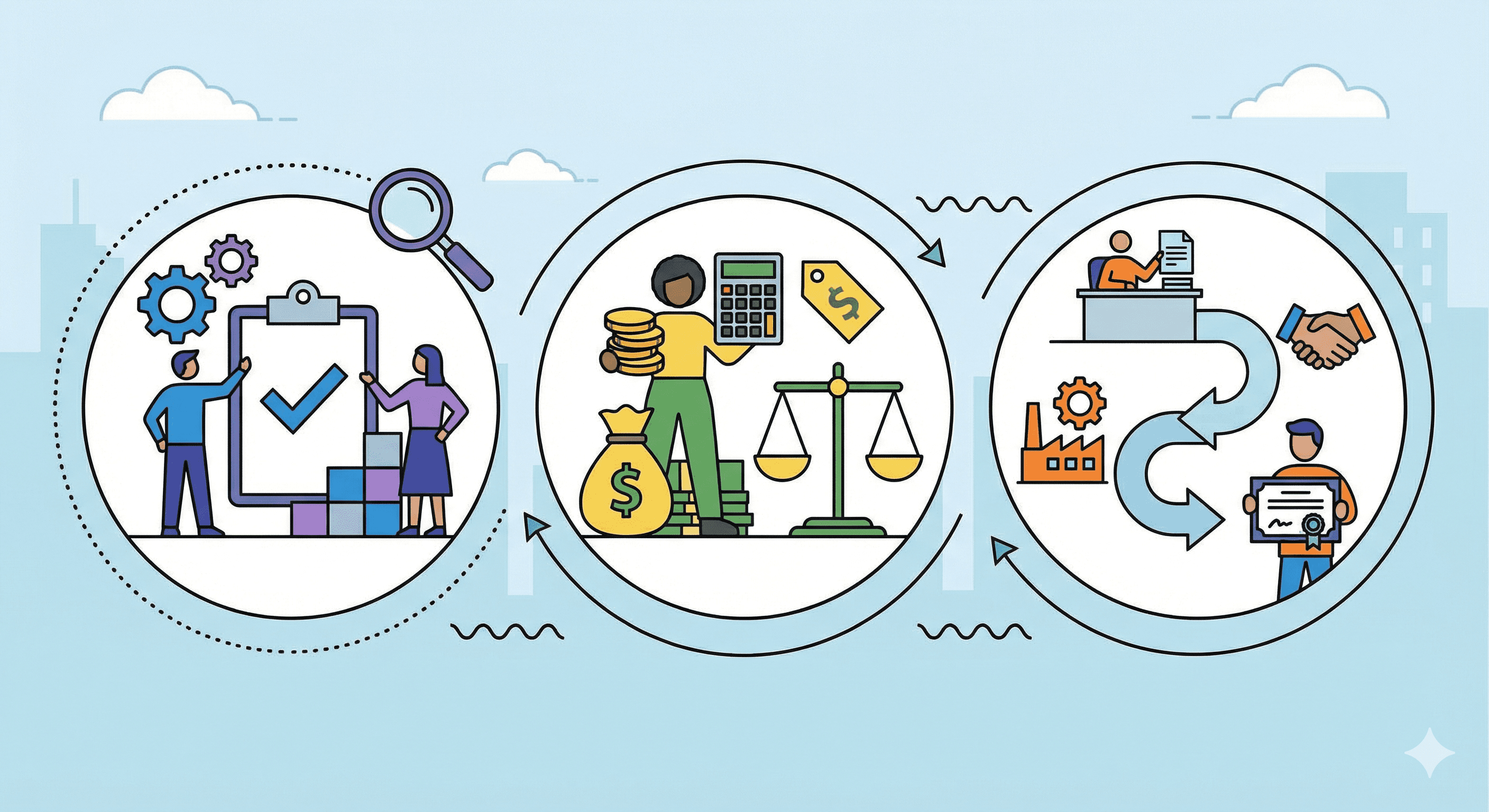
When budgeting for ISO 42001 certification, there are several factors to consider, such as implementation, internal preparation, certification audits, and more.
Cost Factors
There are many different ways to determine the total costs that come with the ISO 42001 certifications. Some of these variables include the
Company size and employee count
Number of AI systems included in the scope
AI complexity and level of risk
Geographic locations
Compliance maturity (if you have ISO 27001 or SOC 2 already)
Certification body of your choice
The implementation process for companies with strong governance frameworks is likely to be faster and more affordable.
Estimated Cost Range
Since ISO 42001 is a relatively new standard, pricing is expected to vary significantly due to the limited available data. Estimated costs vary widely depending on scope, organization size, and audit requirements. Example ranges may include:
Startup / Small Companies: $10,000 to $30,000
Mid-Size Companies: $25,000 to $70,000
Enterprise Companies: $60,000+
Pricing depends on factors such as company size, scope of AI systems, and the complexity of the technology involved.
Hidden Costs
Indirect costs will also significantly impact the total budget and must be added to the other costs. These costs usually include internal resources, training and awareness programs, advisor fees, documentation and governance tools, and the preparation required for internal audits.
Common ISO 42001 Certification Challenges
Companies may encounter several challenges during ISO 42001 implementation.
Governance Challenges: Slow implementation can arise due to lack of executive alignment, unclear accountability, and undefined ownership of AI systems.
Technical Challenges: AI monitoring, transparency, and explanation impose extra controls and documentation.
Documentation Challenges: Risk assessment, policies, and AI documentation typically call for iterative and cross-sectional efforts.
Organizational Challenges: ISO 42001 often requires coordination across multiple teams, effective resource management, and strong collaboration between engineering, legal, compliance, and product functions.
Is ISO 42001 Certification Mandatory?
Currently, ISO 42001 certification is not legally mandatory, but the requirements for the governance of AI are subject to regulations in a developing state, specifically with the AI Act in the EU, where governance, transparency, and risk management impose requirements for certain AI systems. As such, ISO 42001 is not legally required, but companies can consider it a guideline for AI governance with the possibility of compliance with the regulation.
Many companies use ISO 42001 proactively to:
Demonstrate AI governance maturity
Prepare for regulatory developments
Support customer and procurement requirements
How Roz Supports ISO 42001 Certification Engagements
ISO 42001 engagements can become documentation-heavy and complex. Roz helps CPA firms and advisory teams by providing a structured, AI-native workspace for managing ISO 42001 engagements.
Roz Helps With
Documentation & Evidence Organization: Roz acts as an intelligent enterprise data room, providing client-specific workspaces, centralized documentation, and evidence traceability.
AI-Assisted Workpapers: Roz acts as an intelligent enterprise data room, providing client-specific workspaces, centralized documentation, and evidence traceability.
Control Mapping & Gap Analysis: Roz helps identify controls from policies and points out any missing documentation through organized analysis.
Engagement Workflow Support: Audit teams can use risk and control matrix views and structured workflows to support audit preparation.
By organizing documentation and supporting first-pass analysis, Roz helps teams prepare for ISO 42001 engagements more systematically and consistently.
Conclusion
ISO 42001 represents an emerging framework for AI governance and risk management. As AI adoption increases, organizations are evaluating structured approaches to managing AI lifecycle risks, accountability, and transparency. While ISO 42001 is still evolving, early adoption may help organizations establish governance foundations and prepare for emerging regulatory and customer expectations.
If your company wants to streamline its audit and advisory workflows, look at how Roz can assist in your first ISO 42001 certification engagement.
Frequently Asked Questions
What’s the difference between ISO 42001 and ISO 27001?
ISO 27001 is centered on information security and protecting data from breaches. ISO 42001 is focused entirely on artificial intelligence, addressing unique challenges like algorithmic bias, model transparency, and ethical AI lifecycle management.
How long is the certificate valid?
An ISO 42001 certificate is generally valid for three years. During this period, companies undergo annual surveillance audits to confirm they are maintaining their compliance standards.
Is ISO 42001 mandatory?
It is not legally mandatory at this time. However, many organizations adopt it to align with emerging regulations, such as the EU AI Act, and to meet enterprise procurement expectations.
What is ISO 42001 used for?
It is used to establish a structured AI Management System (AIMS). Companies use it to govern the responsible development and use of AI, manage associated risks, and prove their commitment to ethical AI practices to external stakeholders.